


IsoSkills Oy is the go-to company for organizations looking to find professional IT development, testing and management services in Finland and nearshore Romania. Nowadays expanding on the Global IT market with our specialist software services from Bucharest center in Romania.
We are helping many companies to implement and scale their IT projects with our specialists or develop their vision into viable IT software solutions and services. Our teams are experienced in providing excellent consultancy services to our clients. Growing our services in Nordics, IsoSkills has built the reputation of leveraging new technology and methodology, engaging talent for our clients efficiently and effectively.
Economy of Romania
Romania’s economy ranks 35th in the world with some of the highest growth rate in the EU. Romania is a leading destination in Central and Eastern Europe for foreign direct investment. Romania is the largest electronics producer in Central and Eastern Europe. In the past 20 years Romania has also grown into a major center for mobile technology, information security, and related hardware research. The country is a regional leader in fields such as IT and motor vehicle production. Bucharest, the capital city, is one of the leading financial and industrial centres in Eastern Europe. (wiki/Economy_of_Romania)
Romanian IT market volume reached EUR 5.9 billion in 2019, 5.5% of the GDP, with 78% consisting of exports, IT services make up almost 20% of Romania’s total export volume. It’s estimated that by 2022 the market volume of IT will reach EUR 7.3 billion, meaning a 25% yearly growth rate.
Romanian’s international relations are very good, developing constantly largely in recent years, both on the level of political-diplomatic dialogue, as well as at the economic and IT sectorial level.
Outsourcing, Nearshoring benefits
Outsourcing
It is important for companies to have a smart and right outsourcing strategy, a good understanding of why they need to outsource, nearshore, why they need to go abroad. These reasons will be the drivers for their decisions and for the next steps. The reasons will differ from running business at reduced costs, including the raw materials and labour at lower costs, access to local marketplace, taking benefit of particular skills, better logistics hub, reducing new recruitment risks especially during difficult economical period, or outsourcing repetitive skills abroad while taking on more value-added activities in the origin country.
Offshoring to far east (e.g. India) was largely adopted in the past, especially in the IT sector, with the main perceived benefit of reduced costs. Not all have been successful due to many issues in the destination country associated with offshoring: lack of proper infrastructure, collaboration problems due to cross cultural differences, hight traveling expenses and effort, local governance issues with local branch or partner, insufficient communication and large costs to oversight the local business.
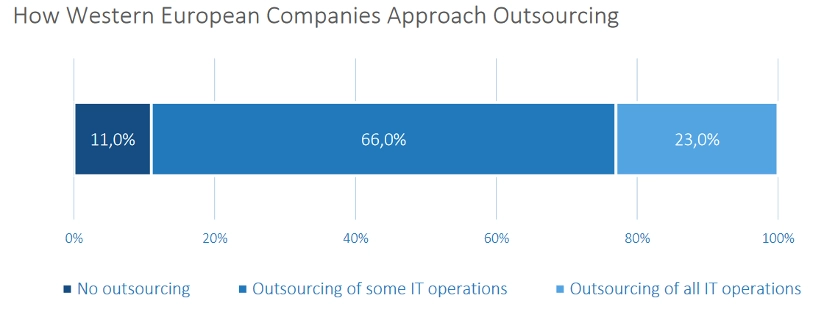
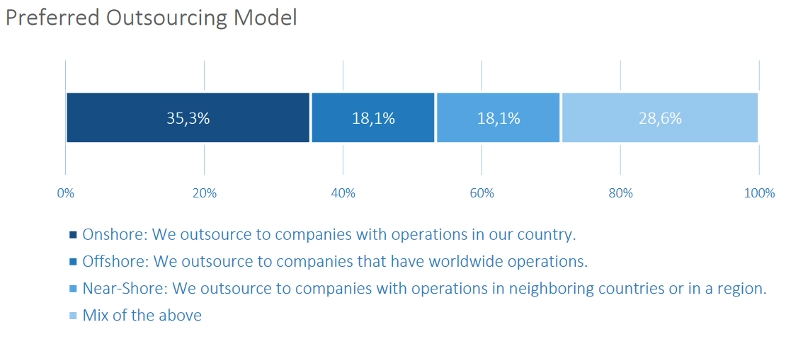
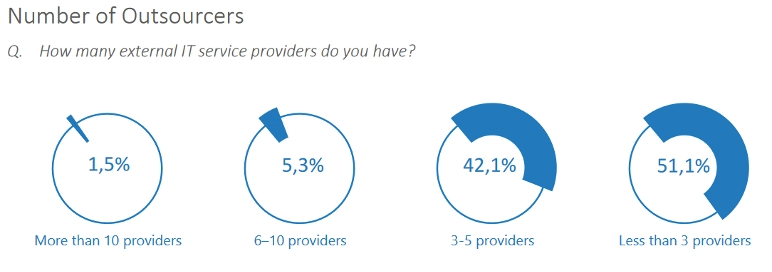
(Source: IDC Survey, 2019)
Offshore and Nearshore models utilization has slightly increased during last year in the context of standardization of the IT work from home procedures.
Outsourcing allows companies to focus on core business development while solving their capacity issues.
IT services that usually fit to outsourcing (either project based or managed delivery):
- Software Development and DevOps
- Software Testing (manual, automation, performance, security)
- IT infrastructure and Cloud management services, including IT monitoring
- Datacenter and Callcenter services, User support
- Security services
Main outsourcing challenges that could appear in some cases:
- Slippage from QoS and SLA conditions
- Security related issues
- Lengthy response times
- Services more expensive than expected
- Weak cooperation between companies
- Not enough customer business knowledge of the partner
- Customer people spending too much time on providing support to outsourcing partner or adapting processes and documentation’s language
In terms of costs, onshoring delivery is in many cases more costly as own employment but many times it compensates due to temporality of the assignments and volumes. Instead, nearshoring provides clear benefits generating 30-40% more savings than inhouse arrangements, and even more compared to onshoring. See below a calculation example of the total costs of engagement compared between inhouse-onshoring-nearshoring models.

Nearshoring
Nearshoring is the outsourcing of business development or operational processes, especially IT activities, to another company in a nearby country, taking advantage of the geographical proximity which translates in less expensive travel, fewer time zone differences, fewer cultural discrepancies and a higher degree of control and speed in decision-making processes.
Nearshoring ensures a more sustainable business climate with fewer drawbacks than offshoring.
Transition to nearshoring is also easier due to proximity of transfer activities without to compromise on their quality and schedules.
Nearshoring to EU area countries it also makes it easy nowadays to adhere to similar high Corporate Social Responsibility standards and especially the new enforced GDPR policy.
If you decide to nearshore, the biggest challenge is to find the right partner. It is your business risk and investment, so make sure you get a trusted productive partner.
Searching for a nearshoring partner on internet it will yield a lot of results, but how to trust and clarify who will be the best fit? You can of course use referrals from a trusted source and talking to others who went through similar experiences. Or, you could contact local agencies who could direct to outsourcing companies in the area. If applicable, you can also consider multiple partners for your services outsourcing, especially big companies could consider a combination of onshoring, offshoring and nearshoring to maximize the benefits of all worlds. Once the agreement starts, you’d need to keep an open communication and collaboration, harvesting on the partnership and gaining the nearshoring advantages.
There are a series of factors to consider in your outsourcing analysis and nearshoring planning:
- Scope of the outsourcing nearshoring: You can start with a smaller scope and extend based on a clearly defined plan. Identify the activities, processes and services which are a fit to outsourcing as they are or with minimum transformation. Which of your business lines have growing needs to be outsourced? Do you need just staff augmentation or more strategic partnerships to bring market experience, knowledge, innovation, and business expertise of new technologies and methodologies? Where you don’t have enough internal resources? Where do you need to change the delivery model (project based or managed delivery)? Think where do you lack qualified resources for new technologies that are difficult to be obtained from the local market? Evaluate CAPEX vs OPEX and cost cutting possibilities. For the whole nearshoring scope, prepare a transfer and/or ramp-up plan and align accordingly with your partner.
- Consider the best outsourcing model: Time and material versus fixed price delivery for outsourced deliverables. In this regard consider your project scales, complexities, timelines and budgets, client required control, requirements stability, development methodologies. Would your processes and time to market fit to outsourcing? Evaluate if you need a partner with vertical industry knowledge, business area expertise or not necessary? Would your internal language communication model fit to nearshoring? In some cases, you need to devise and align some transformation plan with your outsourcing. Consider security and regulatory related required adherence and GDPR policies; in most of the cases nearshoring within EU area is the only valid option when security requirements are set at the high level.
- Communication: It’s a very important general aspect; it is also related to language and cultural aspects. Is good to have a partner who knows how to bridge the interaction, a partner who eventually already has cultural experience of both countries, a company that already operates in both countries. It will be anyway a joined effort for both parts to tune in the communication model. You may need to adapt some of your documentation to English language if not using English fully in internal official communication yet.
- Easiness and willingness to travel: Preferable to regularly meet each others, have workshops and reviews. This will be easier to achieve with a partner already having an office in Finland.
- Technology and methodology expertise: Make sure the partner has expertise in the area you have the need and is interested and ready to improve and scale. Ask references of past projects. Ask evidence of existing role profiles and capacity to bring more. Get your technical teams to discuss with vendor’s technical people early in the process.
- Eventually have a field trial: Try to ask your potential partner to prove the expertise in a smaller scale project. Practice the planning, reporting, scheduling, real time communication and collaboration processes and tooling.
- Meet and greet before signing the cooperation agreement. Communicate your expectations early, make sure they are clearly understood and included into agreement. Plan a proper knowledge transfer with both face to face and online workshops.
- When larger nearshoring teams are involved is a good practice, at least in the beginning to have few of your representatives traveling and working from time to time close to your partner teams, and/or some of the vendor representatives working close onsite with your teams.
- QoS indicators: You may want to define some quality of service indicators your partner would need to adhere to.
- Monitor, scale, adjust and improve the collaboration continuously.

Outsourcing to a Partner in Romania
Romania has been for some years now, a county of interest for companies to outsource their software development in Europe, due to important factors as having a large pool of talent skilled on latest technologies, competitive prices and excellent timely delivery.
General benefits of outsourcing to a partner in Romania:
- Cost savings
- Access to considerable large workforce and talent pool
- Good communication, English language skills
- The right price-cost ratio
- Flexible delivery models (dedicated/shared teams, T&M/fixed price)
- Fast time to market and flexibility
- Transparent and good processes governance
- Good mixed technical and soft skills expertise
- Trustworthy suppliers that can guarantee privacy of customer data and the integrity of the projects.
- Good infrastructure for office spaces and internet
- Access to Romanian and to the Eastern European markets
- Economic and politic stability
- VAT deductions for IT sector, resulting in well paid competent and happy workforce
Particular benefits of nearshoring to Romania:
- Cross-cultural old collaboration
- Proximity of on-site expertise
- Reduced cost of required oversight
- Short travel trip, about 2 hours direct flights anywhere in Europe
- Low travel expenses
- Easy cooperation, effective and efficient real time alignment due to similar time zone within Europe.
- Simplified financial and legal matters as being inside same EU area.
Let’s see a bit more what makes from Romania a preferred IT outsourcing destination when it comes to cultural, communication, talent, costs and living considerations; plus a comparison to some other Easter European countries.
Culture, Communication, Language, Time zone, Infrastructure
Romanian work ethics is strong, with a lot of initiative, innovation, flexibility, hard work, motivation, willingness to travel and hospitality. Overtime is usually practiced for an extra piece of excellence in the work or whenever needed to achieve targets and performance. Planning is sometimes less developed, but it can be tuned in easily. There is a big and active business community and entrepreneurship spirit nowadays.
English knowledge is largely spoken in Romania in the day to day business activities, more than 80% of technical people speak an advanced level of English. Additionally, other European languages such as German, French, Spanish and Italian (plus Hungarian and Russian) are also used which attracts many European companies to establish partnerships or open their own centers of sw development and support for their IT products and services.
The close geographical position also means many cultural similarities. Romania is part of EU and NATO. Time zone in Romania is EET (GMT+2), same with Finland and close to the other European countries, which means that communication is always at hand when it comes to calls and meetings, all the activities are handled during the working hours in both countries.
Traveling to Bucharest by plane can be done in a couple of hours with direct flights from Helsinki (3 per week), so face to face interaction from time to time, management meetings and working workshops can be easily arranged to boost trust and productivity of the work.
Working time is 8 hours per day.
Internet connection speed and quality ranks on top of the world in the big cities (Bucharest capital city is revealed as the Best City in the World for Remote Working https://lnkd.in/d9Q35HA). Some older buildings require attention but usually the new office spaces are quite excellent for their quality and costs, with many A class business buildings where internet, utilities and maintenance are included. Using own car in big cities could be time consuming and difficult from getting a parking space, but this is usually same in any big city around the world, however the taxies are quite cheap and reliable using mobile applications, and metro transportation good. The land and greenfield developments are cheap.
Talent, Employment, Technologies, Pricing
Romania is a European leader in certified IT professionals, also has a variety of technical schools and universities including IT SW Computing, Telecommunications, Automation, Electronics, Cybernetics, Management, etc. The Romanian universities have been quite appreciated by multinational companies and Romania has many informatics, physics and math international medals, more than any other European country. During last years, educational system has helped the universities to provide skills according to international market needs.
With a total population of about 20 mil people, Romania has around 120k developers working for 20000 companies in 5-7 big cities (Bucharest, Cluj, Timisoara, Iasi, Brasov) and more than 8000 developers are coming every year from universities benches offering business stability and good growth. It is relatively easy to hire well educated and trained employees. However, in some areas the competition is big, and salaries are rising. Education focuses on theoretical knowledge and employees have a solid background they can build on during their career. More and more students are already working in sw development and testing during their university years, gaining a lot of practical experience as well quite early.
Job market is lively, a company can relatively easily attract and build a team with substantial size.
Technologies coverage is quite large, among specialities are:
- SW Development and Architecture, Solutions design and transformation to micro-services, SW engineering, DevOps, Fullstack, Java, Frontend, C/C++ embedded, .Net / C#, Mobile iOS and Android.
- Testing and Test management, Test Automation (Python, Java, Selenium, Appium, Robot Framework), Performance (jMeter) and Security Verification and Validation. Quality Assurance and Process improvement. Test maturity audits.
- Program, Project and Service Delivery Management. SCRUM master and Agile coaching. IT Business development and Agile transformation.
A large number of specialists are holding professional technological certifications.
Romania is also attractive for IT nearshoring due to its competitive prices. You can get from Romania high technical proficiency with great work quality at a fraction of the costs from western countries, often better than other Eastern European countries as well. It includes labour, research, production and living costs. Average hourly rates from a trusted tech partner are ranging about 25-50 eur from professional IT support to expert SW architecting and development work. Delivery versus cost is excellent with the right setup in place.
Among well-known local brands and latest successful start-ups are BitDefender, UiPath, FintechOS, and TypingDNA.
Latest decade of excellent delivery in IT makes from Romania a preferred software development nearshoring partner for European countries and generally for the global market.
Romania is top positioned in the context of Easter European outsourcing having several differentiators compared to other states.
| Romania | Poland | Ukraine | Czech | Hungary | Belarus | |
| EU member | yes | yes | no | yes | yes | no |
| EET zone | EET | EET -1 | EET | EET -1 | EET -1 | EET +1 |
| Talent pool size (v for + 100 k, – less) | v | v | v | v | – | – |
| New tech graduates (v for +7k, -less) | v | v | v | v | v | v |
| English language skills (v for high, -less) | v | v | – | v | v | – |
| Other languages | v | v | v | |||
| EU culture affinities | v | v | v | v | ||
| Relative Geographical Proximity | v | v | v | v | v | v |
| Price-cost ratio (v for 25-50 eur/h, + more) | v | + | v | + | + | v |
| Good infrastructure (office and internet) | v | v | v | v | v | v |
| City hubs (more than 4 big cities) | v | v | v | v | v | |
| Large market access | v | v | v | |||
| Economic and politic stability | v | v | v | v | ||
| Tax exemptions for IT sector | v | v | v | |||
| Oversight level required (v normal, + more) | v | v | + | v | v | + |
| Low operational / living costs | v | + | v | + | v | v |
| Corporate taxes (v under 20%, + more) | v | + | + | + | v | v |
Same indicators above apply more or less when compared with other EU (Bulgaria, Portugal, Slovakia, Slovenia & Baltic countries) or non-EU (R Moldova, Croatia) countries in the area.
Establishing own branch in Romania
Steps:
- Hiring a business consultant and a juridical consultant
- Hiring a company Administrator and a Bookkeeper.
- Register the company to the Romanian National Trade Register Office (requires local presence, use a specialized company, most of the documents should be done in Romanian language)
- Open company bank account (administrator)
- Check for office space to dedicated websites (use a specialized company)
- Hire HR and Recruitment managers/specialists and build your team
The standard corporate tax is 16%. In case of micro companies, the tax is 1% or 3%, depending on the number of employees. VAT is 19% for most of the goods and services except for food and beverages (9% VAT) and books, magazines, museum tickets, hotel accommodation services and eco-food products (5% VAT). The pension insurance is 25%, health insurance 10%, and the income tax 10% of the salary. These are paid by the employees. The work insurance contribution (2.5%) is paid by the employer. Tax exemption is offered for some categories: IT, research and innovation, construction and architecture.
Cultural issues and ease of doing business
- Official language: Romanian
- Other languages used: English, French, German, Hungarian (in Transylvania), Italian, Spanish
- Hierarchy: Quite strict and based on age and position. Professional titles and surnames are used.
- Greetings: A firm handshake with eye contact is the standard. Some Romanian men might kiss the hand of a woman they meet. Only close friends exchange kisses on the cheeks when meeting.
- Communication: direct and frank, but also sensitive and courteous.
- Business culture: Formal, reserved, polite, bureaucratic. Great respect is paid to more senior people. Punctuality is valued. Appointments should be planned in advance but there is flexibility. Formal business attire is required in many cases.
- Business relationships: Business relationships are based on mutual trust. Time and in-person meetings are needed for the relationship to develop. Personal questions shouldn’t be asked at early stages of the relationship. Once a relationship has been developed, it is personal; if personnel change, new relationship must be built. It is advisable for the previous contact to introduce their replacement to Romanian partners.
- Meetings: Formal, often dominated by the senior decisionmaker whose decisions are rarely challenged by those of lower rank. There is often a strict seating protocol.
- Presentations: Facts and figures should be used to back up conclusions. Exaggerated claims should be avoided as Romanians prefer honesty and modesty in business. Confrontational behavior and high-pressure sales tactics should be avoided.
- Gifts: It is not common for Romanians to invite foreign business partners to their homes, but if invited, gifts such as flowers, chocolate or high-quality drink are appreciated.
(source: businessfinland.fi)
IT infrastructure is good but administrative digitisation is a little behind with some more advancements made lately to reduce bureaucracy.
When selecting the location for your branch or partner, take into account traveling through the country takes time, the roads infrastructure is still to be better developed. However, direct quick flights between the big cities are now possible. Although some other cities can make it, best locations for software development and testing type of work for middle to large companies are Bucharest and Cluj, best one for support type of work is Iasi. Best for German speakers are Sibiu and Brasov.
Many big multinational companies have made Romania their strategic partner in specialized IT services: Siemens with over 2.000 local employees, Oracle with its European development and call centers in Bucharest providing support in 13 European languages, HP software development centers, Accenture and Genpact in Cluj; IBM in Brasov; Microsoft and Wipro in Timisoara; Ubisoft in Craiova or Continental Automotive in Iasi and Sibiu; Capgemini and Amazon in Iasi, and many more.
While working or traveling to Romania, there are also a lot of activities in the cities (sports, cultural, leisure) or great vacation places (e.g. Black Sea, Danube River and Delta, Carpathian Mountains) where you can relax and refresh yourself to keep you in good shape and performant at work.
In the covid-context situation, Romania has implemented similar personal and organizational responsibility measures as all EU countries, from masks usage, social distancing, modern healthcare facilities, work from home where possible, traveling restrictions from certain risk areas and self-quarantine.
Few notable statements about Romania
– “We invest here because it’s a good place to find highly trained employees.
Romanians are well educated and most of all they are problem solvers. They try resolve
things when others just stop.”
Safra Catz, CEO at Oracle Corporation, quoted in ROMANIA-INSIDER, 20 May 2014
– “One of Romania’s biggest strengths is its wealth of technical talent.”
Journalist Allison Coleman, “Europe’s Hidden Entrepreneurial Tech Hotbed; Romania Powers Up,”
in FORBES Magazine, 27 March 2014
– “20 per cent of our experts in cyber security are from Romania.”
Rob Wainwright, head of Europol — the 28-nation European Union’s law enforcement agency,
speaking to a press conference in Bucharest on 23 April 2015
– “Romania has become a very attractive place, with a growing culture of
entrepreneurship and an unsaturated ecosystem of startups.”
Canadian entrepreneur Alec Saunders, Senior Director at Microsoft Ventures, quoted in the online
ROMANIA-INSIDER English-language newspaper, 22 June 2016
Reflection, and more about IsoSkills services
Reflection
Romania is one of the most attractive markets in Europe for technology investment and outsourcing, with a highly skilled and diversified workforce, competitive prices, and a stimulating business environment. Despite some political turbulence, Romania’s economy and IT sector has seen continuous growth over the past decade. Known for their broad technical expertise, their flexibility, enthusiasm and excellent language skills, Romania’s software service providers are a great choice for long-term collaborations in nearshoring business.
Romania is well known for its people’s good humor and hospitality, factors that sometimes can make a difference for a great collaboration atmosphere, creating synergy in between companies and people, in both work and life situations.
If you decide on outsourcing and nearshoring, our smart-shoring recommendation is to invest in the collaboration with a well-established partner, preferable one having multicultural experience, being capable to easily bridge the activities, a partner with good business acumen, technological and soft-skills competences, a passionate achiever with growth potential and long term cooperation interest.
Benefits of outsourcing to IsoSkills
IsoSkills is an international IT engineering and management company offering outstanding solutions, outsourcing and consulting services. The company was established in Helsinki in 2016 and in Bucharest in 2017 on its founders’ solid background in IT SW engineering and management achieved during many years of consultancy in Finnish, Romanian and Global markets.
We provide high-quality solutions and services by ensuring that exceptional delivery is our absolute focus. We are specialized in Software Development, Quality Assurance and IT Management consultancy.
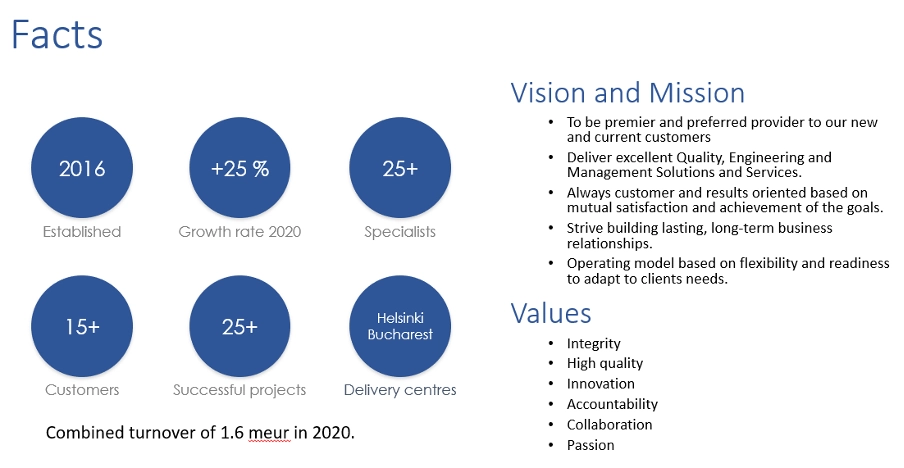
With 100% customer retention during the last years, IsoSkills is the go-to company for organizations looking to find professional IT services.
IsoSkills already has a good presence in Finland, Helsinki area, and Romania, Bucharest area. IsoSkills Oy office is in Regus Otaniemi business center. IsoSkills Bucharest office is in a new developed north area in premier A class business centre.
In Finland, we help the clients to implement and scale their IT projects with our specialists or develop their vision into viable IT solutions.
In addition, we serve many customers from our development center in Bucharest at high quality and competitive prices. Both local and international companies are benefiting from our high competences in Full-stack software development, Testing and DevOps IT engineering.
Our main capabilities are:
- Software Product Development (Architecture, Development and DevOps utilizing Java, C, C++, .Net, php, among others, for web-server, mobile and embedded solutions)
- QA and Testing (manual, automation, performance, security, test maturity evaluation)
We also address IT management activities and engage Transformation & Innovation services (Project and Service management, Agile transformation and coaching, Business & process analysis, RPA and Process improvement, Cloud technology, Artificial Intelligence, AR/VR technologies).
Industries:
- IT ERP, Web Retail and Media
- Embedded, Automotive, Industrial devices
- Mobile, Telco, Satellite and Aviation
- Financial and Banking
- Healthcare
- Gaming
- IT Infrastructure and End-User Services
Collaboration and Delivery models:
- On demand specialists (onsite/nearshore)
- Project based resources and deliveries
- Managed services (on agreement basis)
- Full solution development (design, implementation and delivery based on the customer requirements)
We have a large pool of educated and qualified developers and testers. We have great existing portfolio and client references. We can provide quotation for any development and test service.
We have available software engineers with short notice and possibility to recruit more quickly for larger projects. We have flexible price lists and highly qualified profiles at hand to share with our clients. We mainly work with senior specialists and we largely cover most of the software development and testing technologies. We have long and strong expertise and QA and testing (functional, automation, performance, cybersecurity, and management). We have performed QA maturity audits for several Finnish companies, and we are helping them to evolve their testing with clearly defined improvement plans.
Among other international and local clients, in Bucharest we work with several Finnish based clients: a Finnish lead organization in escalators business (web testing, automation and performance), a telco lead company (java, cloud security development and cybersecurity assessment), a few outsourcing companies (web-mobile development, functional testing, test automation), a spin off the University of Jyvaskyla (web framework and mobile application development in Telco area), and with a maritime solutions leader (C# backend and frontend development, and manual testing).
Keep Your Business Running Smoothly With Onsite And Nearshore SW Development And Testing Services from A Reliable IT Services Partner. Contact Us To Be The Next Happy Customer!
Our policy statement: ¨We put Customers and Consumers at the heart of everything we do. We provide excellent service by ensuring collaboration, innovation and exceptional delivery are our absolute focus. ¨
- Bogdan Papuc, Executive Management, Global Services, IsoSkills
- papuc@isoskills.fi
- +358405953380 / +40753404588
- Vasile Marcovici, Managing Director, IsoSkills, Romania
- marcovici@isoskills.fi
- +40720058245
- Jaana Vaananen, Business Development and Sourcing Director, IsoSkills Oy
- vaananen@isoskills.fi
- +358505253693
Info sources of this guide:
– Ministry of Foreign Affairs, Ministry of Public Finance, Ministry of Economy, Energy and the Business Environment, Ministry for Transport, Infrastructure and Communications, National Institute of Statistics, Invest in Romania.
– https://www.ef.com/wwen/epi/, EF English Proficiency Index, 2020
– https://www.state.gov/reports/2020-investment-climate-statements/romania/
– www.idc.com, extensive IT market reports and surveys